

Most people assume that building muscle or regaining strength after an injury requires heavy lifting. That assumption stops a lot of people from making progress. Research shows that muscle and strength can be built using surprisingly light weights through blood flow restriction therapy (BFRT). For anyone dealing with chronic pain, recovering from surgery, or stuck in a rehab plateau, that changes everything. This article walks you through what BFRT is, the science behind it, who benefits most, how it’s safely applied, and what realistic expectations look like.
Key Takeaways
| Point | Details |
|---|---|
| Low-load, high-impact | BFRT allows you to build muscle and strength without heavy lifting, ideal for pain and injury rehab. |
| Personalized protocols matter | The benefits and safety of BFRT depend on individualized pressure settings and professional supervision. |
| Broad applications | BFRT is effective for post-injury recovery, chronic pain, arthritis, and situations where traditional exercise isn’t possible. |
| Know the limitations | BFRT is not a one-size-fits-all solution and may not always outperform conventional strength therapy for every patient. |
What is Blood Flow Restriction Therapy?
Blood flow restriction therapy is not a new exercise trend. It is a clinically guided technique that uses specialized cuffs or tourniquets placed on the upper arm or upper leg to partially restrict blood flow during low-load exercise. The goal is to create a physiological environment that mimics what happens during heavy strength training, without the joint stress that comes with it.
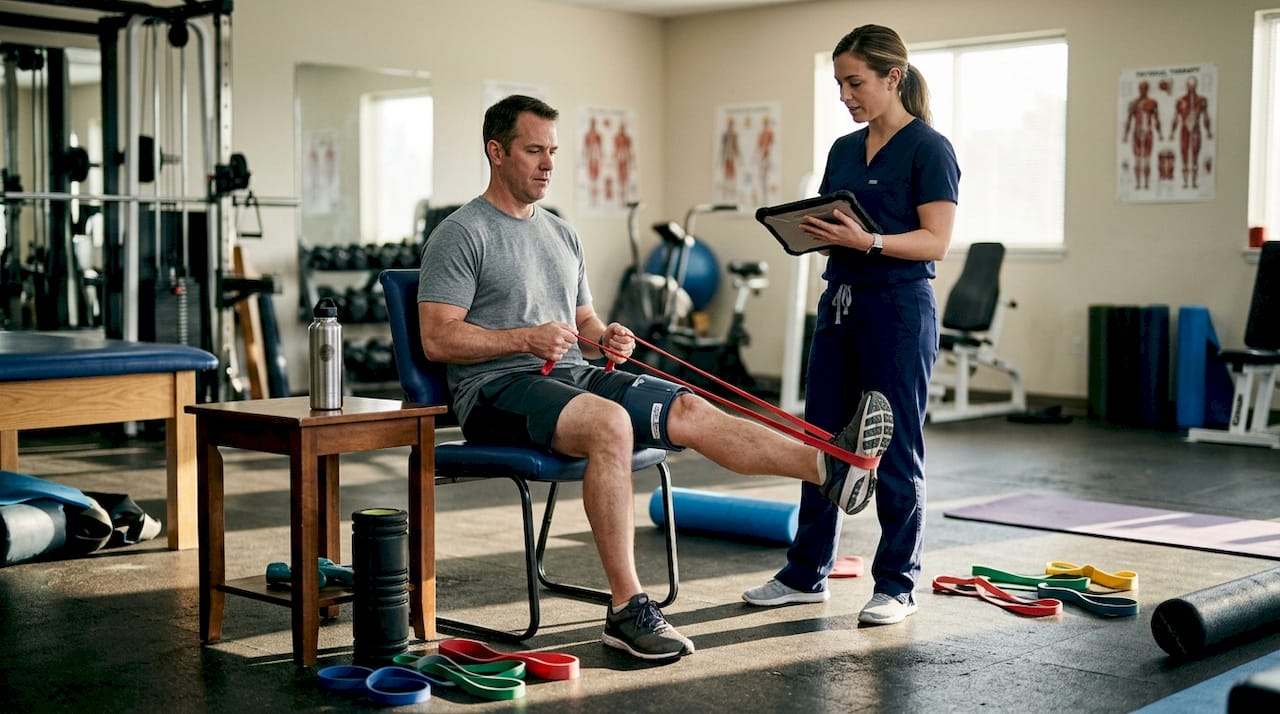
BFRT involves applying cuffs to the limbs to restrict venous outflow (blood leaving the muscle) while maintaining arterial inflow (blood entering the muscle). This creates a pooling effect that forces the muscle to work harder under low loads, typically 20 to 40 percent of a person’s one-repetition maximum (1RM). In traditional strength training, you would need to lift 70 to 85 percent of your 1RM to achieve similar adaptations.
Additionally, this therapy is also known by other names. BFRT is also called BFR training or KAATSU training, with KAATSU being the original Japanese term developed in the 1960s. Today, physical therapists, athletic trainers, sports medicine physicians, and rehab specialists use it across a wide range of clinical settings.
Here is a quick look at what makes BFRT different from traditional exercise:
- Low load, high adaptation: Exercises are performed at 20 to 40% 1RM instead of the usual 70%+
- Cuff placement: Positioned at the most proximal (uppermost) part of the limb
- Partial restriction only: Arterial flow continues; venous return is limited
- Short sessions: Typically 15 to 20 minutes per session
- Versatile modes: Can be applied to walking, cycling, resistance bands, or bodyweight exercises
“The key insight behind BFR training is that the body responds to the metabolic environment inside the muscle, not just the weight on the bar. Restrict outflow, and the muscle behaves as if it’s working much harder than it actually is.”
Physical therapists who use BFRT protocols design sessions around each patient’s limb occlusion pressure, exercise tolerance, and recovery goals. This is not a one-size-fits-all tool. It is a precision technique that requires clinical training to apply correctly.
How Does BFRT Work? Mechanisms and Science Explained
Now that you know what BFRT is, let’s tackle how it delivers such powerful results. The short answer: it tricks your body into a high-effort response using low effort input. The longer answer involves four overlapping mechanisms.
BFRT creates metabolite accumulation, fast-twitch fiber recruitment, cell swelling, and hormone increases, mimicking the internal environment of high-load training. Each of these plays a distinct role in driving adaptation.
| Mechanism | What happens | Effect on the body |
|---|---|---|
| Metabolite accumulation | Lactate and hydrogen ions build up | Stimulates growth hormone release |
| Fast-twitch fiber recruitment | Low oxygen forces recruitment of larger fibers | Increases strength and hypertrophy |
| Cell swelling | Fluid shifts into muscle cells | Signals protein synthesis |
| Systemic hormone response | IGF-1 and growth hormone spike | Supports muscle repair and growth |
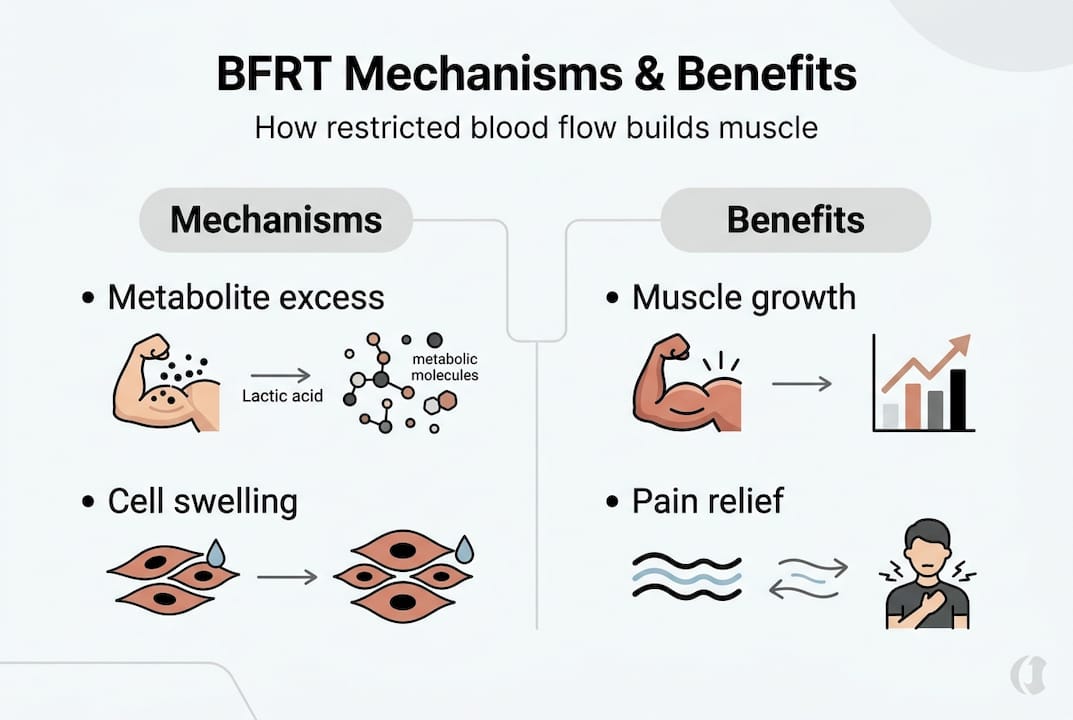
One of the most exciting applications of BFRT is pain relief. Restricting blood flow during exercise triggers the release of endogenous opioids and endocannabinoids, which are the body’s own natural pain-reducing compounds. This effect, called exercise-induced hypoalgesia, can provide meaningful relief for people with chronic musculoskeletal pain. It is not just about building muscle. It is also about resetting how the nervous system processes pain signals.
For instance, people recovering from BFR training recovery benefits, this dual action, building tissue while reducing pain, makes BFRT especially valuable in early-stage rehab when traditional loading is not yet safe.
Pro Tip: Pay attention to how your muscles feel during and after BFRT sessions, not just your performance numbers. Fatigue, mild burning, and temporary swelling are normal. Sharp pain, numbness, or tingling are not. Report those immediately to your therapist.
Who Can Benefit? Real-World Applications in Rehab and Pain Management
With the science explained, let’s see who stands to benefit most from BFRT and who should be cautious. The answer is broader than most people expect.
BFRT is effective for chronic pain, post-ACL recovery, osteoarthritis, and rehab with joint constraints. It is particularly useful when traditional loading is contraindicated or simply too painful to tolerate. Research and meta-analyses of BFRT continue to expand the list of conditions where it shows measurable benefit.
Here are the patient groups that tend to see the strongest outcomes:
- Post-surgical recovery: ACL reconstruction, rotator cuff repair, total knee replacement
- Chronic pain conditions: Fibromyalgia, tendinopathy, patellofemoral pain syndrome
- Osteoarthritis: Especially in the knee and hip where loading is painful
- Older adults: Sarcopenia (age-related muscle loss) without the injury risk of heavy lifting
- Athletes in early return-to-sport: Maintaining muscle mass while protecting healing tissue
- Anyone with load limitations: Stress fractures, bone healing, acute soft tissue injuries
Consider ACL recovery as a concrete example. Traditional strength training after ACL surgery requires progressively heavier loads to rebuild the quadriceps. But in the first weeks post-op, those loads can stress the graft and delay healing. BFRT allows a patient to low-load preserves joints while driving hypertrophy, rebuilding quad strength without overloading the repair site. That is a clinically significant advantage.
For those managing pain management therapy alongside structural rehab, BFRT fits naturally into a broader treatment plan. It pairs well with advanced therapy options like laser therapy, dry needling, and electrical stimulation.
However, BFRT is not for everyone. People with deep vein thrombosis, peripheral vascular disease, uncontrolled hypertension, or significant cardiac conditions should avoid it unless specifically cleared by their physician. Pregnancy and open wounds at the cuff site are also contraindications.
Pro Tip: Ask your physical therapist whether your condition has been studied in BFRT research. A good clinician will match the protocol to your diagnosis, not just apply a generic template.
Protocols, Personalization, and Safety Considerations
Knowing if BFRT fits your needs, let’s cover how it’s safely delivered and what to expect in practice. The details matter here. BFRT done well is very different from BFRT done carelessly.
Personalized cuff pressures at 40 to 80% of arterial occlusion pressure (AOP), combined with structured set and rep schemes, form the backbone of a safe and effective BFRT session. AOP is the pressure at which arterial blood flow is fully stopped. BFRT uses a fraction of that, not full occlusion.
Here is how BFRT compares to traditional resistance training in terms of protocol structure:
| Variable | BFRT protocol | Traditional resistance training |
|---|---|---|
| Load | 20 to 40% 1RM | 70 to 85% 1RM |
| Sets | 4 (1×30, 3×15 reps) | 3 to 5 sets |
| Rest between sets | 30 to 60 seconds | 2 to 3 minutes |
| Cuff pressure | 40 to 80% AOP | None |
| Joint stress | Low | Moderate to high |
BFRT is generally safe if personalized, with rare adverse events when protocols are properly individualized. The most common side effects are temporary muscle soreness and mild bruising at the cuff site. Serious complications are rare but possible when protocols are applied without proper training.
Here are the key steps that keep BFRT safe in a clinical setting:
- Measure limb occlusion pressure before each session using a Doppler ultrasound or validated device
- Set cuff pressure to the appropriate percentage of AOP based on the patient’s condition
- Monitor for numbness, tingling, or excessive pain throughout the session
- Use wider cuffs for lower pressures and narrower cuffs for upper limbs
- Limit continuous cuff time to no more than 20 minutes per session
- Reassess pressure settings as fitness and limb composition change over time
Personalization is not optional. It is the entire point. A protocol designed for a 25-year-old athlete looks nothing like one designed for a 65-year-old with knee osteoarthritis. Your therapist should be adjusting BFRT applications in rehab based on your baseline, your progress, and your tolerance.
The Uncomfortable Truth: BFRT Isn’t Magic, But it is a Game-Changer for the Right Cases
Here is what most articles won’t tell you about BFRT. The hype is real, but so are the limits.
We have seen patients come in expecting BFRT to fix everything after one session. That is not how it works. BFRT gives short-term pain relief in knee cases, but the added long-term benefit over conventional therapy is still debated. For some patients, it is a bridge to get them moving again. For others, it is a long-term tool in a broader rehab strategy. The difference depends entirely on the person, the condition, and the quality of the protocol.
What we know from working with chronic pain patients is this: the therapy is only as good as the clinical reasoning behind it. A poorly designed BFRT session can be ineffective or even counterproductive. The cuff pressure matters. The exercise selection matters. The timing within the overall rehab plan matters.
We also know that BFRT does not replace the work. It makes the work more accessible. For someone who cannot tolerate heavy loading, BFRT opens a door that would otherwise stay shut. That is genuinely valuable. But it still requires effort, consistency, and realistic expectations. If you are exploring regenerative recovery strategies and wondering if BFRT fits your situation, the honest answer is: it depends on your specific case, and a qualified clinician should make that call with you, not for you.
Explore Advanced Rehab Techniques with RegenTech Physical Therapy
If you are managing chronic pain or working through injury recovery, the right therapy makes a measurable difference. But so does the team delivering it.

At RegenTech Physical Therapy in Lewiston, ID, we design individualized BFRT therapy protocols based on your limb occlusion pressure, diagnosis, and recovery goals. BFRT is one piece of a broader approach that includes Class IV laser therapy, dry needling, shockwave therapy, and electrical stimulation. Our three-phase Regenerate, Restore, Rise model brings these tools together into a plan that fits your body and your timeline. Reach out today to schedule a consultation and find out whether BFRT belongs in your recovery.
Frequently Asked Questions
Is blood flow restriction therapy painful?
BFRT is generally safe and well-tolerated, though you may feel a mild burning or pressure sensation during the session. Most patients adapt quickly, especially when working with a trained clinician who adjusts the cuff pressure to their comfort level.
Who should avoid BFRT?
Contraindications include vascular and cardiac disorders, so people with deep vein thrombosis, peripheral artery disease, or uncontrolled hypertension should not use BFRT without explicit medical clearance. Always disclose your full medical history before starting.
How soon can you expect results from BFRT?
BFRT increases muscle strength and mass comparably to high-load training in the short term, with many patients noticing measurable changes in strength within four to six weeks of consistent sessions. Results vary based on frequency, protocol quality, and the underlying condition being treated.
Does BFRT replace traditional exercise or therapy?
BFRT has benefits but may not add to high-load training outcomes for patients who can already tolerate conventional exercise. It works best as a complement or a bridge when traditional loading is not yet possible or safe.


