

You finish a physical therapy session hoping for real progress, but movement still feels restricted or painful. Generic routines rarely fit the needs of active adults with chronic pain or those recovering from injury in Lewiston. Personalized exercise plans centered on your physiology and capacity build sustainable strength while minimizing setbacks. Research confirms that customized exercise programs enhance cardiorespiratory fitness, muscular strength, and health outcomes more than one-size-fits-all routines. Discover how tailored rehabilitation creates lasting improvement where generic methods fall short.
Personalized Exercise Plans: Core Concepts
There’s a reason why your coworker’s “amazing workout” flopped for you, or why that popular program everyone raves about left you frustrated. Your body isn’t generic. Your history isn’t generic. Your goals aren’t generic. Yet most people start with cookie-cutter routines that ignore what makes them different, then wonder why results stall, or injuries creep in.
Personalized exercise programming means building a plan around your specific physiology, your current capacity, and where you actually are right now—not where you think you should be. Research shows that customized exercise programs enhance cardiorespiratory fitness, muscular strength, and overall health outcomes significantly more than generic approaches. For someone in Lewiston managing chronic pain or returning from injury, this isn’t just about optimization—it’s about building sustainable strength without triggering setbacks.
The Three Categories That Matter Most
Everyone’s starting point is different. Your exercise plan needs to reflect which category you’re actually in, because the priorities shift everything:
- Rebuilding Phase (Returning from Time Away or Injury): Your priority is tolerance. Your body needs proof it’s safe to load again. Progressive exposure through controlled movement teaches tissues that loading is manageable. This is where many people rush and regress.
- High Activity/High Stress Phase: Your priority becomes recovery management. More training stimulus requires more recovery capacity. Without this balance, you accumulate fatigue and invite injury despite feeling “in shape.”
- Pain Management Phase: Your priority is finding a safe entry point, not avoiding all movement. Pain doesn’t mean “don’t move”—it means “move smart.” This is where advanced techniques become invaluable.
The mistake isn’t training hard; it’s training the same way for three different people with three different needs.
How Advanced Techniques Fit Your Personalized Plan
If your plan is built on understanding your specific challenge, certain tools dramatically improve what your body can tolerate. Think of them as removing barriers so your actual training plan works better:
- Class IV Laser Therapy and Shockwave: These calm irritated tissues, so movement feels better and is actually better tolerated. You move more freely, which means your exercise plan has more room to progress.
- Blood Flow Restriction (BFR): This allows strength gains at lower loads, perfect if you’re in the tolerance-building phase or managing pain. You get the strength stimulus without crushing your recovering tissues.
- Electrical Stimulation (E-stim): When movement feels “off,” or activation patterns are disrupted, e-stim helps restore normal muscle engagement. Your exercises then work the way they’re supposed to.
These aren’t replacements for your exercise plan. They’re force multipliers that make your personalized plan actually work.
Building Your Foundation
Your personalized plan needs a framework. Tailoring your routine to your comfort and skill level means three phases in every session:
- Warm-up phase that prepares tissues for what’s coming
- Conditioning phase, where you do the actual work (strength, endurance, mobility—whatever your plan calls for)
- Cool-down phase helps recovery begin
Within the conditioning phase, variables like reps, sets, resistance, and rest periods get adjusted based on your category. Someone rebuilding needs different rep ranges and recovery time than someone managing a heavy training load.
The key detail most people miss: your plan is never static. What works in month one might need adjustment by month three as your tolerance improves, your pain decreases, or your strength gains. Personalized means responsive.
Your exercise plan should evolve as you do. If it’s identical to three months ago, something’s missing.
Why Your Specific Situation Matters
You’re not training to look like someone else or hit arbitrary metrics. You’re training to function better in your actual life. For active adults managing chronic pain or recovering from injury, that means your plan accounts for your real demands and your real constraints.

A 45-year-old returning after six months away faces different tolerances than someone maintaining consistent activity. Someone juggling work, family, and recovery needs a different program complexity than someone with unlimited time. Someone with pain at specific movements needs those movements approached differently, not avoided.
This is why a generic program fails: it can’t know your tolerances. Your personalized plan can, because it’s built on assessment—not assumptions.
Pro tip: Ask yourself: What’s my main priority right now—building tolerance, managing recovery, or finding entry points around pain? Your answer shapes everything in your exercise plan, from exercise selection to volume to how you progress.
Types of Exercise Priorities by Need
Not all exercise time is created equal. Your body doesn’t care if you logged 45 minutes if those 45 minutes weren’t addressing what actually matters right now. This is where priorities come in. The exercise you prioritize should depend on your specific situation—where you are, what you’re recovering from, and what your body needs most.
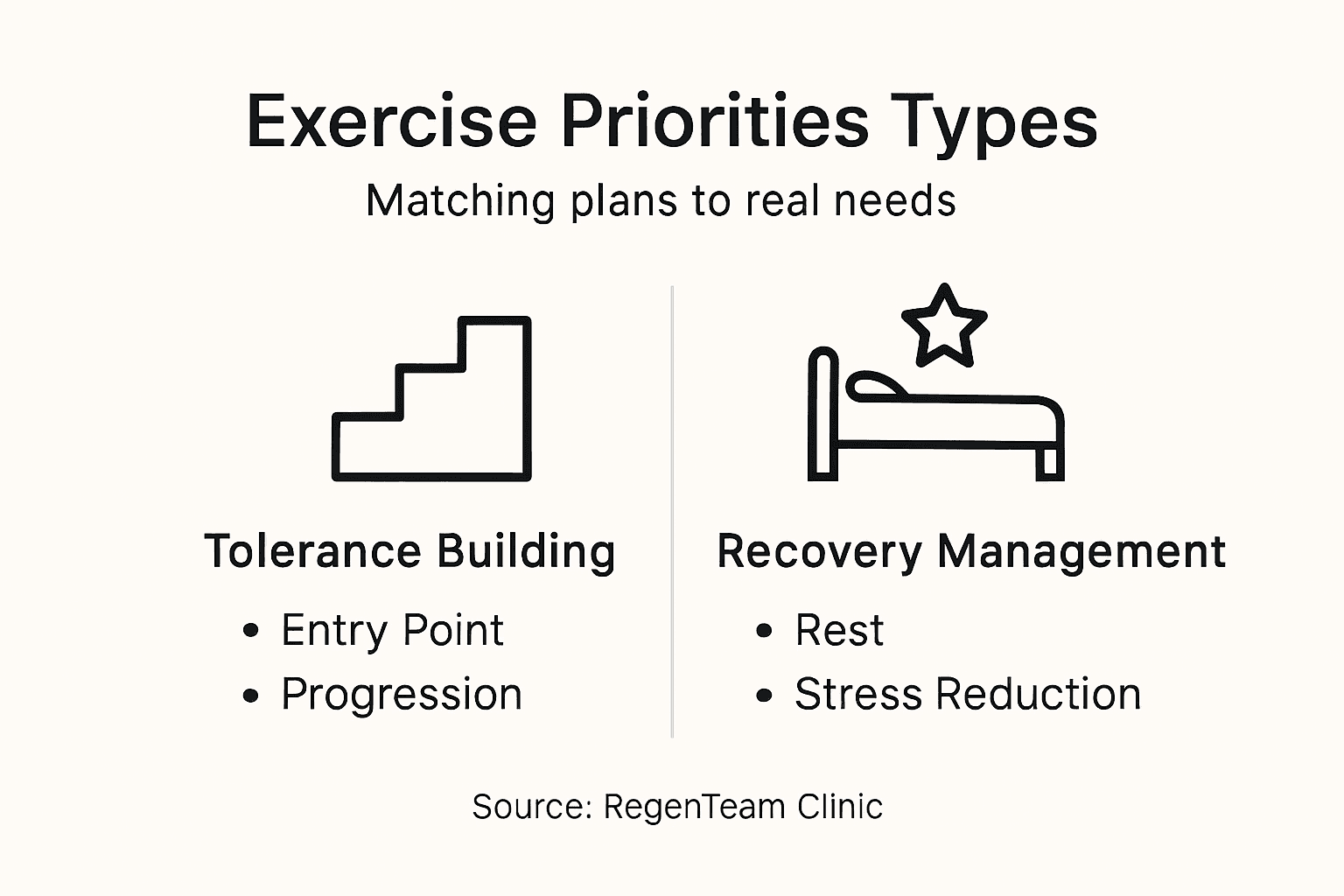
When you’re rebuilding tolerance after time away or injury, your priority flips. You’re not chasing performance gains or training like an athlete. You’re teaching your body that loading is tolerable, that movement can be safe, and that progressive challenge doesn’t mean regression. This phase demands controlled progression: starting with movements your irritated tissues can handle, then gradually increasing how much load or volume they manage.
Standard physical activity guidelines recommend balanced exercise, including aerobic activity, muscle strengthening, balance, and flexibility work. But here’s what most people miss: the proportion and emphasis of these elements shift based on your needs. For someone in the tolerance-building phase, strength work at lower intensities might take priority over cardiovascular conditioning. For someone managing high training loads, recovery-focused mobility and nervous system calming become the priority.
Priority 1: Tolerance Building (Returning After Time Away or Injury)
Your main goal is to prove to your body that movement and loading are safe. This looks different than training:
- Progressive exposure through controlled movements at loads your tissues accept
- Consistency over intensity—showing up regularly matters more than pushing hard
- Pain monitoring, not pain elimination—some discomfort during healing is normal; pain that worsens or lingers past recovery is not
- Joint mobility and tissue preparation before any conditioning work
- Low-velocity, controlled movements that let your nervous system recalibrate
Many people in this phase rush. They feel better for a day, then hammer a workout, then regress for two weeks. The priority isn’t “getting fit fast.” The priority is “never regressing again.” That mindset changes everything about exercise selection and progression.
Priority 2: Recovery Management (High Activity or High Stress)
If you’re training consistently or juggling high stress, your tissues are experiencing accumulated load. Your priority becomes recovery capacity—your ability to absorb training stimulus without breaking down.
This means:
- Sleep prioritization (non-negotiable for active people)
- Mobility and parasympathetic activation work that calms your nervous system
- Deload weeks where you reduce volume and intensity intentionally
- Strategic rest days that actually feel like recovery, not guilt
- Breathing and flexibility work that counteract the tension high training creates
If you’re an active adult juggling work stress plus training stress, you’re asking your nervous system to manage an enormous load. Your exercise plan should include recovery tools, or you’ll keep spinning wheels.
Priority 3: Pain Management (Safe Movement Around Pain)
Pain doesn’t mean “stop moving.” It means “move differently.” Your priority is finding the range where movement improves comfort, not avoiding movement entirely.
This involves:
- Finding entry points—movements that don’t trigger or worsen pain
- Building tolerance gradually through the pain-free range
- Strengthening around pain in ways that improve function
- Using advanced techniques (laser, shockwave, e-stim, BFR) to improve tissue tolerance so your actual exercises work better
Your exercise priority should match your current need. Rebuild if you’re returning. Manage recovery if you’re loaded. Find safe entry points if you’re painful. Doing the wrong priority for your situation wastes weeks.
How Priorities Actually Look in a Week
If you’re in tolerance-building mode, your week might emphasize movement quality, range of motion work, and light resistance with perfect form. If you’re managing high activity, your week might include one heavy strength day, one moderate conditioning day, and three lighter mobility and recovery sessions. If you’re managing pain, your week might center on pain-free movements, regenerative techniques, and gradual range expansion.
The mistake is treating every phase like training. Each phase needs a different lens. Once you know your actual priority, exercise selection becomes obvious. Without it, you’re just exercising, not building toward something specific.
Pro tip: Identify which category best describes you right now, then audit your current plan: Does 70 percent of your exercise time target that priority, or does it get lost in generic programming? Reprioritize accordingly.
Regenerative Therapies That Support Movement
Here’s the thing about chronic pain and slow recovery: traditional approaches often leave you stuck. You complete physical therapy, but movement still feels limited. You rest the injury, but tissues don’t seem to actually heal. You manage symptoms without addressing why your body isn’t recovering the way it should.
This is where regenerative therapies enter. Instead of masking pain or hoping tissues heal on their own, regenerative medicine repairs musculoskeletal tissues by triggering your body’s natural healing response. These aren’t experimental or extreme—they’re clinically proven techniques that work alongside your exercise plan to make movement possible again. For someone in Lewiston managing chronic pain or returning from injury, they can be the difference between stalled progress and real breakthrough.
Think of regenerative therapies as removing obstacles. Your exercise plan is only as good as what your tissues can tolerate. If irritated tendons, damaged cartilage, or disrupted muscle activation are limiting you, the best exercise program in the world won’t work until those tissues improve. Regenerative techniques calm irritation, restore function, and prepare tissues to respond to training. Then your personalized exercise plan can actually do its job.
The Four Core Techniques That Work With Your Exercise Plan
Class IV Laser Therapy uses targeted light energy to reduce inflammation and promote tissue repair at the cellular level. Your irritated tissues calm down, swelling decreases, and movement becomes tolerable. This matters because movement is healing—but you can’t move if pain is too high. Laser creates the window where your exercise plan can progress.
Shockwave Therapy applies controlled acoustic pulses to stimulate healing in stubborn areas—tendons, ligaments, and joints that aren’t responding to traditional approaches. It wakes up your body’s repair mechanisms. Many people report significant pain reduction and improved function within weeks, making training possible again.
Blood Flow Restriction (BFR) is different—it allows you to build strength at much lower loads. Wearing a specialized cuff, you exercise with reduced blood flow, creating a strength stimulus without crushing recovering tissues. This is invaluable during the tolerance-building phase when heavy loading would trigger setbacks.
Electrical Stimulation (E-stim) restores normal muscle activation patterns when your nervous system has “forgotten” how to fire muscles properly. After injury or prolonged pain, your muscles don’t activate the way they should. E-stim retrains that pattern so your exercise work actually engages the right muscles.
Here’s how core regenerative techniques support personalized exercise:
| Technique | Primary Effect | Best Use Case | How It Aids Progress |
|---|---|---|---|
| Class IV Laser Therapy | Reduces inflammation | Severe tissue irritation | Enables early movement |
| Shockwave Therapy | Stimulates tissue healing | Stubborn tendon/joint pain | Accelerates recovery |
| Blood Flow Restriction | Strengthens at low loads | Weakness after injury | Builds strength safely |
| Electrical Stimulation | Restores muscle activation | Poor muscle engagement | Improves exercise quality |
How Regenerative Therapies Fit Into Your Personalized Plan
Regenerative rehabilitation combines therapy with movement restoration to optimize both tissue healing and functional gains. This isn’t replacement—it’s integration. Your therapist uses regenerative techniques to improve what your tissues can handle, then your exercise plan builds on that improved capacity.
The sequence matters. You might start with laser or shockwave to calm irritated tissues. Within days or weeks, your pain decreases, and your movement improves. Then your exercise plan progresses—adding load, increasing range, building strength. As tissues adapt, you might need less frequent regenerative support. Eventually, exercise alone maintains the gains.
This is why personalized plans matter: someone’s tissue healing timeline is different from yours. Someone managing severe chronic pain might need more frequent regenerative support upfront. Someone returning from surgery might benefit from BFR during the early weeks. Someone with muscle activation issues needs e-stim early, then less as patterns normalize.
Regenerative therapies remove the ceiling on what your exercise plan can accomplish. Without them, pain and tissue irritation limit progress. With them, your body can actually respond to training.
The Real-World Impact
You’re not looking for a miracle cure. You’re looking for a way to actually heal and get back to the activities that matter to you. Regenerative therapies do that by addressing tissue-level problems that exercise alone can’t fix. They’re the bridge between “I’m in pain” and “I can train effectively.”
For active adults in your situation, this changes everything. You’re not choosing between rest and pushing through pain. You’re choosing smart rehabilitation that combines tissue healing with progressive movement. That’s how you build lasting strength without setbacks.
Pro tip: Ask your therapist which regenerative technique addresses your specific tissue problem first, then ask how it changes what your exercise plan can accomplish in the next 4-6 weeks. That’s your roadmap.
How Individual Needs Shape Your Program
You could follow the same workout as your neighbor. Same exercises. Same sets and reps. Same schedule. You’d both be exercising, but only one of you would get better. The difference isn’t effort—it’s fit. Your program needs to match your actual situation, not someone else’s.
This is why generic programming fails for people managing chronic pain or returning from injury. Physical activity needs vary by age, health status, and circumstances, which means tailoring your exercise plan to your specific condition is what actually moves the needle. A plan built for you accounts for your pain patterns, your recovery capacity, your tissue tolerances, and your real-world demands. A generic plan ignores all of it.
Your program shape is determined by answers to specific questions: Where are you starting? What’s limiting you most right now? What does success look like in your actual life? Are you managing a high training load or rebuilding from minimal activity? Is pain your ceiling or just background noise? These aren’t rhetorical—they determine everything about exercise selection, intensity, frequency, and progression.
The Assessment Foundation
Every personalized program starts with an honest assessment. Not what you wish you could do. Not what you did six months ago. What you can actually do right now, pain-free or with manageable discomfort.
This includes:
- Movement capacity: Which movements feel good? Which ones trigger pain or limitation?
- Pain behavior: Is pain constant or movement-triggered? Does it improve with activity or worsen?
- Recovery needs: How quickly do you recover from activity? Do you wake up sore or bounce back in hours?
- Life demands: Are you sedentary most days or highly active? Do you have stress that affects recovery?
- Tissue status: Are tendons irritated, muscles weak, joints stiff, or activation patterns disrupted?
- Training history: Are you returning after time away or maintaining consistent activity?
Customizing plans to individual fitness levels and health conditions increases adherence and effectiveness because the program actually fits your life. When your program ignores these factors, it becomes a frustrating mismatch between what the plan prescribes and what your body can tolerate.
How Different Needs Create Different Programs
Three people walk in with “knee pain.” Same diagnosis, completely different programs:
Person A: Recently stopped running due to patellar tendon irritation. Pain decreases with light activity. Main need: tolerance building through controlled progression.
Program shape: Emphasizes pain-free range, mobility work, light resistance, frequency over intensity, and gradual load increases. Regenerative therapy (laser) reduces tissue irritation, so movement progresses faster.
Person B: Trains four days weekly with persistent knee achiness. Recovers slowly between sessions. Main need: recovery management and deload structure.
Program shape: Includes heavy strength work but adds strategic deload weeks, extensive mobility work, sleep prioritization, and possibly reduced training frequency. This person doesn’t need lighter exercise—they need smarter recovery.
Person C: Chronic knee pain from a previous injury. Limited range, weak around the knee. Main need: a safe entry point and strengthening without aggravation.
Program shape: Focuses on pain-free exercises, BFR work for strength at lower loads, shockwave therapy to improve tissue tolerance, and very gradual range expansion. Pace is slower but sustainable.
Same body part. Same diagnosis. Three completely different program structures because needs are different.
Your program works when it’s built on what’s actually limiting you, not what you think should be limiting you.
The Variables That Shift Based on Your Needs
Once the assessment identifies your main need, everything adjusts:
- Exercise selection changes based on what your tissues tolerate
- Volume and intensity shift depending on recovery capacity
- Frequency adjusts for your tolerance and life demands
- Progression timeline matches your healing rate, not a generic template
- Recovery modalities (sleep, mobility, regenerative techniques) are integrated based on your specific bottleneck
- Pain management strategy differs depending on pain behavior
Someone rebuilding needs longer warm-ups, lower intensity, and frequent progressions. Someone managing a high training load needs less conditioning and more recovery work. Someone with chronic pain needs careful exercise selection and possibly regenerative support upfront.
Your therapist designs around your needs, not around what works for most people. That’s the difference between a program and a personalized program.
The Real Impact
When your program matches your actual needs, three things happen. First, you get better faster because every session targets what’s actually limiting you. Second, you avoid setbacks because the program respects your tolerances. Third, you stay consistent because the program fits your life instead of fighting it.
For active adults managing pain or rebuilding capacity, this matters enormously. You’re not looking for generic fitness. You’re looking for sustainable improvement in function. That only happens when your program is built for your specific situation.
Pro tip: Before starting any program, write down: What can I do pain-free today? What do I want to do but currently can’t? What’s one thing that would prove my program is working? Use those three answers to shape your program expectations.
Comparing Personalized Versus Generic Plans
Generic plans are convenient. Download a program, follow it exactly, done. But convenience isn’t the same as effectiveness. A generic plan works for whoever it was written for—not necessarily you. For someone managing chronic pain or rebuilding after injury, that distinction matters tremendously.
Here’s the core difference: A generic plan assumes everyone has the same tolerance, the same recovery capacity, the same pain response, and the same goals. It can’t be true. You walk into rehabilitation with a unique combination of tissue damage, pain patterns, nervous system sensitization, movement history, and life demands. A program that ignores those variables will either bore you with exercises you’ve outgrown, frustrate you with exercises your body can’t tolerate, or leave you spinning wheels because the program doesn’t address what’s actually limiting you.
Personalized exercise plans tailored for individual health status improve outcomes more effectively than one-size-fits-all recommendations. This isn’t specific to one condition—it applies across chronic pain, injury recovery, and performance. When a plan accounts for your personal situation instead of generic averages, adherence increases, progress accelerates, and setbacks decrease.
What Generic Plans Get Wrong
Generic programs fail because they can’t adapt to individual reality. Here’s what they typically miss:
- Pain behavior: They prescribe the same intensity and volume for someone with constant pain and someone with movement-triggered pain. These need completely different approaches.
- Recovery capacity: They ignore how quickly you actually recover. Someone sleeping six hours and managing high stress recovers differently than someone sleeping nine hours with low stress.
- Tissue tolerances: They use average progression rates instead of matching your healing timeline. Pushing a recently injured tendon on a generic schedule causes setbacks.
- Life demands: They don’t account for your job, family stress, or training load outside the program. Someone juggling high external stress needs a different recovery structure.
- Movement history: They treat a beginner and someone returning after six months the same way, missing the unique challenge of rebuilding.
Generic plans work if you’re the person they were written for. Most people aren’t.
What Personalized Plans Actually Do
A personalized plan starts with assessment, not assumptions. It answers specific questions about you:
- What can you do pain-free today?
- What’s limiting you most right now—pain, weakness, stiffness, or poor activation?
- How quickly does your body recover from activity?
- What does success look like in your actual life?
- What exercises aggravate versus improve your situation?
Then everything builds from those answers. Exercise selection targets your specific limitations. Volume and intensity match your recovery capacity. The progression timeline follows your healing rate. Recovery strategies address your bottleneck. Pain management approaches match your pain behavior.
This requires ongoing adjustment. Personalized plans show better alignment with individual needs through iterative input because, as you progress, your needs shift. What works in month one might need adjustment by month three. A generic plan can’t do that—it stays static while you change.
The Measurable Difference
The comparison is stark. Generic plans produce moderate results inconsistently because they’re not targeting your actual problem. Personalized plans produce consistent results because every session works on what’s limiting you.
Specifically:
Generic Plan: You follow a program written for ordinary people. Some exercises feel pointless. Others trigger pain. The recovery structure doesn’t match your needs. You make progress, but not efficiently. You might have setbacks because the program pushes past your tolerance. You stick with it for three weeks because it doesn’t feel like it’s addressing your situation.
Personalized Plan: You follow a program built for your situation. Every exercise targets something you need to address. Intensity respects your tolerances. Recovery structure matches your capacity. Progress is consistent because the program adjusts as you improve. You stick with it because it actually works and feels sustainable.
The difference isn’t theoretical. It’s reflected in completion rates, satisfaction, and actual outcomes.
Compare the two main program approaches for clarity:
| Attribute | Generic Plan | Personalized Plan |
|---|---|---|
| Starting Point | Assumes average ability | Assesses actual capacity |
| Pain Management | One-size-fits-all | Adjusted to pain type |
| Adaptability | Rarely changes | Evolves as you progress |
| Long-term Outcome | Inconsistent improvements | More consistent progress |
Generic plans work despite being generic. Personalized plans work because they’re personalized. For someone rebuilding or managing pain, that’s the difference between moderate progress and transformation.
Why This Matters for Your Situation
You’re not training for fun or to compete with someone else. You’re training to function better, manage pain, and rebuild the capacity you’ve lost. That requires a program built on what you actually need, not what works for most people.
Active adults in Lewiston managing chronic pain or returning from injury need program design that respects their tissue tolerances, acknowledges their pain patterns, and matches their recovery capacity. That’s not a luxury—it’s the foundation of success.
A generic plan might eventually get you somewhere. A personalized plan gets you there faster, with fewer setbacks, and with higher confidence that you’re doing the right thing.
Pro tip: If your current program hasn’t been adjusted in eight weeks despite your progress, it’s probably too generic for where you are now. Ask your therapist: What changed about my program this month based on how I’m responding? If the answer is “nothing,” it’s time to personalize.
Build Your Exercise Plan Around What Matters Most to You
If you are struggling with chronic pain or recovering from injury, following a generic workout plan can lead to frustration and setbacks. Your body’s unique needs and tolerances require a personalized approach that focuses on building tolerance, managing recovery, or safely moving around pain, as highlighted in the article. RegenTech Physical Therapy specializes in combining advanced regenerative treatments like Class IV laser therapy and blood flow restriction with a customized three-phase program designed to help you Regenerate, Restore, and Rise stronger than before.
Ready to stop guessing what your body can handle and start a program built specifically for your situation? Visit RegenTech Physical Therapy to discover how our innovative treatments and tailored exercise plans work together to accelerate healing and improve your function safely. Learn more about our Regenerative Therapies and how a personalized plan can transform your recovery journey. Don’t wait until pain controls your life—take control now with expert care built just for you.
Frequently Asked Questions
Why is a personalized exercise plan important?
A personalized exercise plan is essential because it considers your unique physiology, history, and goals, which helps optimize training effectiveness and minimize injury risk.
What are the main categories of exercise priorities?
The three main categories are: 1) Rebuilding Phase, focusing on tolerance; 2) High Activity/High Stress Phase, focusing on recovery management; and 3) Pain Management Phase, focusing on finding safe movement.
How do regenerative therapies support exercise plans?
Regenerative therapies, such as laser therapy and shockwave therapy, help reduce tissue irritation and improve recovery, allowing your personalized exercise plan to be more effective.
What factors should I consider when assessing my exercise needs?
When assessing your exercise needs, consider your movement capacity, pain behavior, recovery needs, life demands, and training history to create a plan that fits your specific situation.
Recommended


