

Living with ongoing pain in Lewiston can make even simple activities feel overwhelming, especially when recovery seems out of reach. Understanding that pain is influenced by your nervous system, past experiences, and emotional state, not just injury, is a vital step toward effective healing. If you are seeking relief, personalized physical therapy combined with innovative treatments offers new hope for active adults ready to move beyond old myths and find care tailored to their needs.
Understanding Pain: Signals, Myths, and Facts
Pain isn’t just a physical sensation – it’s a complex neurological experience that involves multiple systems in your body. Molecular mechanisms of pain perception reveal a sophisticated interplay between sensory signals, emotional processing, and individual neural pathways.
Contrary to popular belief, pain doesn’t always indicate active tissue damage. Our nervous system can generate pain signals based on perceived threat, past experiences, and psychological states. Advances in pain research demonstrate that pain is fundamentally a protective mechanism designed to prompt action, not simply a direct indicator of injury.

Scientists now understand pain through three primary categories: nociceptive (direct tissue damage signals), neuropathic (nerve system disruptions), and nociplastic (central nervous system sensitization) pain. Each type represents a unique neurological response with distinct characteristics. These categories help medical professionals develop more targeted treatment approaches that address the specific pain mechanism rather than applying a one-size-fits-all solution.
Here’s a summary comparing the three main pain types discussed in modern research:
| Pain Type | Main Cause | Key Characteristics | Typical Treatments |
|---|---|---|---|
| Nociceptive | Direct tissue injury | Aching, sharp or throbbing | Rest, anti-inflammatory meds |
| Neuropathic | Nerve system disruption | Burning, shooting, tingling | Nerve-targeted medications |
| Nociplastic | Central nervous sensitization | Diffuse, persistent pain | Gradual exercise, cognitive therapy |
Pro tip: When experiencing persistent pain, document its characteristics – location, intensity, duration, and triggering factors – to help healthcare professionals accurately diagnose and treat your specific condition.
When to Rest and When to Move Safely
Navigating the delicate balance between rest and movement during recovery requires strategic thinking and careful listening to your body. Art of rest in rehabilitation highlights that total immobilization can often be more detrimental than thoughtful, progressive movement.
Understanding when to rest and when to move depends on several critical factors. Acute injuries typically require short periods of protection and reduced activity, while chronic conditions benefit from gentle, controlled movement that maintains joint mobility and muscle strength. The key is distinguishing between pain that signals potential harm and discomfort that represents normal adaptation and healing.
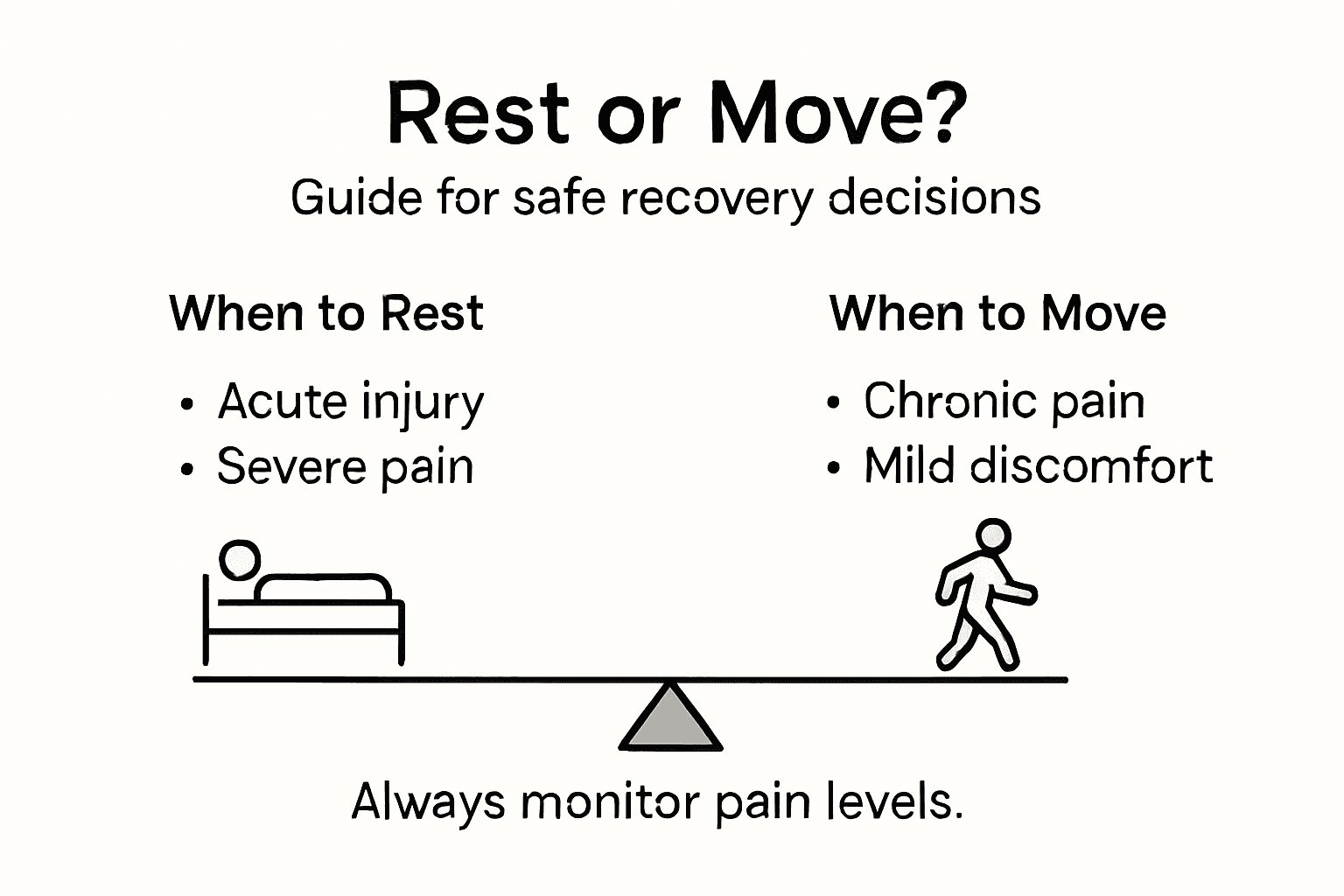
Effective recovery involves a nuanced approach to movement. Start with low-intensity activities that don’t exacerbate pain, gradually increasing complexity and resistance as your body demonstrates readiness. This might mean gentle range-of-motion exercises, light stretching, or specific rehabilitation movements prescribed by a physical therapist. Always monitor your body’s response, paying attention to pain intensity, duration, and recovery time after activity.
The following table outlines differences between rest and movement strategies during recovery:
| Situation | Rest Priority | Movement Priority | Example Activity |
|---|---|---|---|
| Acute Injury | Short-term protection | Limited, pain-free motion | Immobilization, gentle ROM |
| Chronic Condition | Avoid prolonged rest | Encourage graded, sustained movement | Stretching, progressive loading |
| Post-Surgery | Follow medical guidance | Gradual increase as tolerated | Physical therapy, walking drills |
Pro tip: Use the “two-hour rule” – if increased pain persists more than two hours after activity, you’ve likely done too much and should scale back your movement intensity.
Assess, Modify, Progress: The RegenTech Approach
The RegenTech approach represents a sophisticated methodology for managing pain and recovery, rooted in regenerative rehabilitation science. This framework moves beyond traditional treatment models by emphasizing a dynamic, responsive strategy that adapts to your body’s unique healing process.
The three-phase approach begins with Assessment, a critical step where practitioners carefully evaluate the extent of injury, tissue condition, and individual physiological responses. Unlike static treatment plans, this phase involves comprehensive diagnostics that map out precise intervention strategies. The goal isn’t just to identify problems, but to understand the underlying biomechanical and neurological factors driving your pain experience.
Once assessment is complete, the Modification phase kicks in. Here, practitioners design targeted interventions that balance protection and stimulation. This might involve specialized techniques like controlled movement protocols, strategic loading of healing tissues, and individualized exercises that promote tissue regeneration without overwhelming the body’s natural healing mechanisms. The key is creating an environment that supports recovery while preventing further stress or potential re-injury.
Pro tip: Keep a detailed recovery journal documenting your pain levels, movement capabilities, and response to different interventions to help your healthcare team fine-tune your personalized rehabilitation strategy.
Fear, Recovery, and Building Confidence
Pain isn’t just a physical experience – it’s a complex psychological journey that can profoundly impact your confidence and movement patterns. Cognitive functional therapy approaches reveal that our emotional response to pain often matters more than the pain itself, creating a critical pathway for recovery that goes far beyond physical rehabilitation.
Fear acts as a powerful barrier in recovery, creating a cycle of avoidance that can actually increase disability and prolong healing. When we’re afraid of movement, our nervous system becomes hypersensitive, interpreting normal sensations as potential threats. This protective mechanism, while well-intentioned, can actually restrict healing by limiting muscle activation, reducing blood flow, and preventing the gradual reconditioning necessary for true recovery.
Breaking this fear cycle requires a strategic approach that combines gentle exposure, education, and psychological support. Practitioners help patients reframe pain narratives, understand that discomfort doesn’t always mean damage, and gradually rebuild confidence through controlled, progressive movement experiences. By creating safe environments for exploration and learning, individuals can rediscover their body’s resilience and capacity for healing.
Pro tip: Practice daily micro-movements that feel safe, gradually expanding your comfort zone by 1-2% each week to rebuild confidence without triggering significant pain responses.
Knowing When to See a Physical Therapist
Recognizing the right moment to seek professional help can be crucial for preventing long-term complications and accelerating recovery. Clinical practice guidelines provide clear indicators that signal when professional physical therapy intervention becomes necessary.
Some key signs suggesting you should consult a physical therapist include persistent pain lasting more than two weeks, pain that disrupts daily activities, reduced range of motion, recurring injuries, or difficulty performing routine tasks. These symptoms indicate that your body needs more than basic self-care and could benefit from professional assessment and targeted rehabilitation strategies.
Your physical therapy consultation becomes especially critical when pain demonstrates specific characteristics: sharp or shooting sensations, pain that radiates down limbs, sudden changes in strength or sensation, or discomfort that doesn’t improve with rest. These nuanced signals suggest underlying biomechanical issues that require expert evaluation. Physical therapists can diagnose movement patterns, identify potential root causes, and design personalized treatment plans that address your specific functional limitations.
Pro tip: Document your pain patterns, including intensity, duration, and activities that trigger or alleviate discomfort, before your first physical therapy appointment to provide comprehensive information.
Innovative Therapies for Persistent Pain
Persistent pain is no longer a one-size-fits-all challenge, thanks to groundbreaking advancements in medical technology. Cutting-edge pain management strategies are revolutionizing how we understand and treat complex pain conditions, moving far beyond traditional pharmaceutical interventions.
Today’s innovative therapies include regenerative approaches like platelet-rich plasma (PRP) injections and targeted neuromodulation technologies that can interrupt pain signals at their neurological source. These techniques go beyond symptom management, addressing underlying biomechanical dysfunctions and promoting actual tissue healing. Advanced spinal cord stimulation and dorsal root ganglion interventions can now provide precise, personalized pain relief for conditions that previously seemed untreatable.
The future of pain management is increasingly personalized, with artificial intelligence playing a transformative role in treatment design. By analyzing individual patient data, molecular biomarkers, and neurological imaging, clinicians can now develop highly targeted therapeutic strategies that address the unique mechanisms driving each patient’s pain experience. This precision approach means treatments can be fine-tuned to an individual’s specific physiological responses, dramatically improving potential outcomes.
Pro tip: When exploring innovative pain therapies, always request comprehensive diagnostic imaging and molecular assessments to ensure the most targeted, personalized treatment approach.
Take Control of Your Recovery with Proven Solutions
When pain shows up unexpectedly or persists despite your best efforts, it can feel overwhelming and confusing. This article highlights the critical need to understand pain types and carefully balance rest with smart movement to support healing. At RegenTech Physical Therapy, we specialize in helping you navigate these challenges using a personalized three-phase approach called Regenerate, Restore, Rise that targets your unique pain mechanisms, whether it is nociceptive, neuropathic, or nociplastic.
Our clinic in Lewiston, ID, integrates advanced modalities like Class IV laser therapy, shockwave therapy, and electrical stimulation designed to accelerate healing, reduce inflammation, and rebuild confidence in your body’s natural abilities. By combining targeted regenerative treatments with expert guidance on movement and pain management, we provide a comprehensive path forward for those dealing with joint soft tissue, chronic, or pelvic pain.
Discover how our tailored strategies can transform your recovery journey by visiting our Pain Relief & Recovery Archives – Regentech Physical Therapy and explore the latest Innovative Treatments Archives – Regentech Physical Therapy that redefine healing.

Ready to stop wondering what to do when pain appears and start taking informed action? Connect with RegenTech Physical Therapy today at https://regentechpt.com to schedule your personalized assessment. The sooner you act, the faster you can rise above pain and regain your movement with confidence.
Frequently Asked Questions
What should I do if I experience persistent pain?
If you have pain lasting more than two weeks, it is essential to consult a physical therapist for an assessment and targeted rehabilitation strategies.
How can I determine if I should rest or move when injured?
Acute injuries typically need short periods of protection, while chronic conditions benefit from gentle, controlled movements. Monitor your pain levels and adjust activities accordingly.
What are the different types of pain, and how are they treated?
Pain can be categorized into nociceptive, neuropathic, and nociplastic types, each requiring specific treatment approaches ranging from medication to targeted therapies.
When is it necessary to see a physical therapist for pain management?
You should see a physical therapist if you have persistent pain, reduced range of motion, or pain that disrupts daily activities, especially if there’s a change in strength or sensation.
Recommended


