

Chronic joint pain has a way of wearing you down. You try rest, ice, anti-inflammatory medications, and maybe even a round of traditional physical therapy, and yet the ache in your heel, knee, or shoulder keeps coming back. If you live in Lewiston, ID, and you’re tired of treatments that only mask the problem, shockwave therapy may be the turning point you’ve been waiting for. Meta-analyses confirm ESWT is superior to control treatments for both pain relief and function in chronic musculoskeletal conditions. This guide walks you through everything you need to know, from how it works to what happens in the treatment room.
Key Takeaways
| Point | Details |
|---|---|
| Non-invasive quick relief | Shockwave therapy is a needle-free, surgery-free pathway to pain relief, often with immediate results. |
| Ideal for chronic pain | Best for persistent tendon and soft tissue injuries where other methods haven’t worked. |
| Accessible in Lewiston | Lewiston, ID residents can access expert shockwave therapy from local, trusted professionals. |
| Proven long-term results | Clinical evidence shows sustained pain and function improvement up to 12 weeks or more after treatment. |
| Know the limitations | People with certain health conditions may not be candidates, so pre-treatment screening is essential. |
Understanding Shockwave Therapy: What It Is and How It Works
Shockwave therapy is not what the name might suggest. There are no electrical shocks involved. Instead, the treatment uses high-energy acoustic waves, essentially concentrated sound pulses, delivered through the skin to the injured tissue beneath. These waves trigger a cascade of biological responses that your body uses to repair damaged tendons, reduce inflammation, and restore normal function.
The science behind it is grounded in sound wave healing science. When acoustic waves reach injured tissue, they stimulate increased blood flow to the area, break up calcified deposits that form in chronically damaged tendons, and activate the body’s natural tissue regeneration pathways. They also modulate nerve signals, which is why many patients feel pain relief almost immediately after a session.
There are two main types of shockwave therapy you’ll encounter:
- Focused shockwave therapy (FSWT): Delivers energy to a precise, deep target point. Best for localized injuries like calcific tendinitis or deep muscle trigger points.
- Radial shockwave therapy (RSWT): Spreads energy over a wider surface area. Often used for broader soft tissue conditions like plantar fasciitis or shin splints.
As part of a regenerative therapy overview, shockwave fits alongside other advanced modalities because it works with your body’s healing systems rather than simply suppressing symptoms. Research confirms ESWT is superior to control for pain relief, with a mean difference of 1.7 cm on the visual analog scale (VAS), and significant functional improvement in myofascial pain syndromes.
| Feature | Focused shockwave | Radial shockwave |
|---|---|---|
| Depth of penetration | Deep (up to 12 cm) | Shallow (2-3 cm) |
| Best for | Calcific deposits, deep tendons | Plantar fasciitis, broad soft tissue |
| Session intensity | Higher, targeted | Lower, dispersed |
| Common use | Chronic tendinopathy | Trigger points, surface injuries |
For athletes dealing with recurring soft tissue problems, the shockwave therapy for athletes approach often combines both types depending on the injury profile.
Pro Tip: Ask your therapist whether a focused or radial shockwave is planned for your condition. The distinction matters, and a good provider will explain exactly which type they’re using and why.
Preparing for Shockwave Therapy in Lewiston: What You Need to Know
Understanding the science is key, but what about preparation? Here’s how to get ready for shockwave therapy locally.
Not everyone is an ideal candidate, and knowing where you stand before your first appointment saves time and sets realistic expectations. Shockwave therapy works best for people dealing with chronic pain lasting more than three months, particularly in tendons and soft tissues. Common conditions that respond well include plantar fasciitis, Achilles tendinopathy, rotator cuff tendinitis, patellar tendinopathy, and lateral epicondylitis (tennis elbow).
However, some people should not receive shockwave therapy. These include individuals on blood thinners (anticoagulants), those with metal implants or pacemakers near the treatment area, pregnant women, and anyone with an active infection or malignancy at the target site. Always disclose your full medical history before starting.
“Transparency with your provider is not optional. Skipping the screening process is where complications arise. Tell your therapist everything, including all medications, implants, and recent procedures.”
When choosing a provider in Lewiston, Clarkston, and surrounding areas, look for a clinic that conducts a thorough intake assessment, explains the treatment protocol in plain language, and uses calibrated equipment. In Lewiston, ID, RegenTech Physical Therapy offers focused shockwave therapy for chronic tendon pain, plantar fasciitis, and soft tissue injuries as part of a broader regenerative physical therapy program.
Here’s what to bring and do before your first visit:
- Bring any imaging (X-rays, MRI reports) related to your injury
- List all current medications, especially blood thinners
- Wear loose, comfortable clothing that allows access to the treatment area
- Avoid anti-inflammatory medications for 48 hours before your session if possible
- Write down your top three pain complaints and when they’re worst
| Good candidate | Not a good candidate |
|---|---|
| Chronic tendon pain (3+ months) | On anticoagulant medications |
| Plantar fasciitis | Metal implants near treatment area |
| Soft tissue injuries | Pregnant |
| Failed conservative treatment | Active infection at the target site |
For broader pain management options in Lewiston, shockwave is often one piece of a larger plan that may include movement retraining and back pain regenerative rehab, depending on your condition.
Step-By-Step: What Happens During a Shockwave Therapy Session
Once you’ve made your preparations, your first session is next. Here’s how typical shockwave therapy appointments unfold.
Knowing exactly what to expect removes a lot of the anxiety that comes with any new treatment. The process is straightforward, non-invasive, and usually completed within 30 to 45 minutes.
- Arrival and intake review. Your therapist reviews your health history, confirms the target area, and discusses your pain levels using a simple 0-10 scale. This is your chance to ask any remaining questions.
- Locating and marking the treatment area. The therapist palpates (feels) the affected tissue to identify the most painful or restricted zones. These spots are marked to guide the probe placement.
- Application of ultrasound gel. A coupling gel is applied to the skin over the treatment area. This helps the acoustic waves transmit efficiently from the probe into the tissue.
- Shockwave probe application. The handheld probe is pressed firmly against the skin and moved in slow, deliberate circles over the marked area. You’ll feel a rhythmic tapping or vibrating sensation.
- Adjusting intensity. Your therapist will increase the energy level gradually based on your feedback. Mild to moderate discomfort is normal. Sharp or severe pain is not, so speak up.
- Session completion and post-care instructions. Most sessions last 5 to 15 minutes of active treatment time. Afterward, your therapist will advise you on activity modifications and what sensations to expect over the next 24 to 48 hours.
Pain relief is often immediate due to a phenomenon called C-fiber overload, where the acoustic stimulation temporarily saturates pain-signaling nerve fibers. Results are also durable, with improvements holding at 8 to 12 weeks post-treatment.
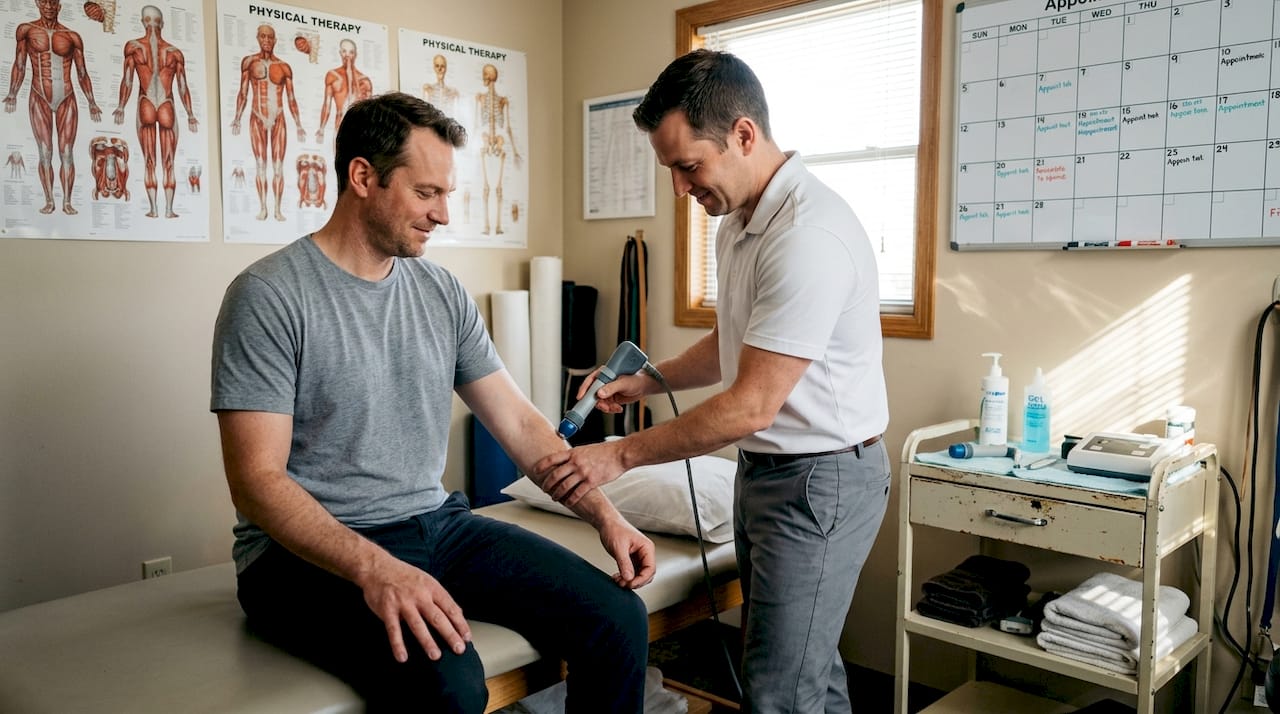
Pro Tip: Don’t push through sharp pain during the session. Mild aching is part of the process, but intense pain signals that the probe placement or intensity may need adjustment. Communicate openly with your therapist throughout.
Understanding the role of PT in recovery helps frame why shockwave is rarely used alone. It works best when paired with targeted exercise and stability for knee pain or other functional rehab goals.
Verifying Results: What to Expect After Shockwave Therapy
After your session ends, you’ll want to know what kind of results to expect and when.
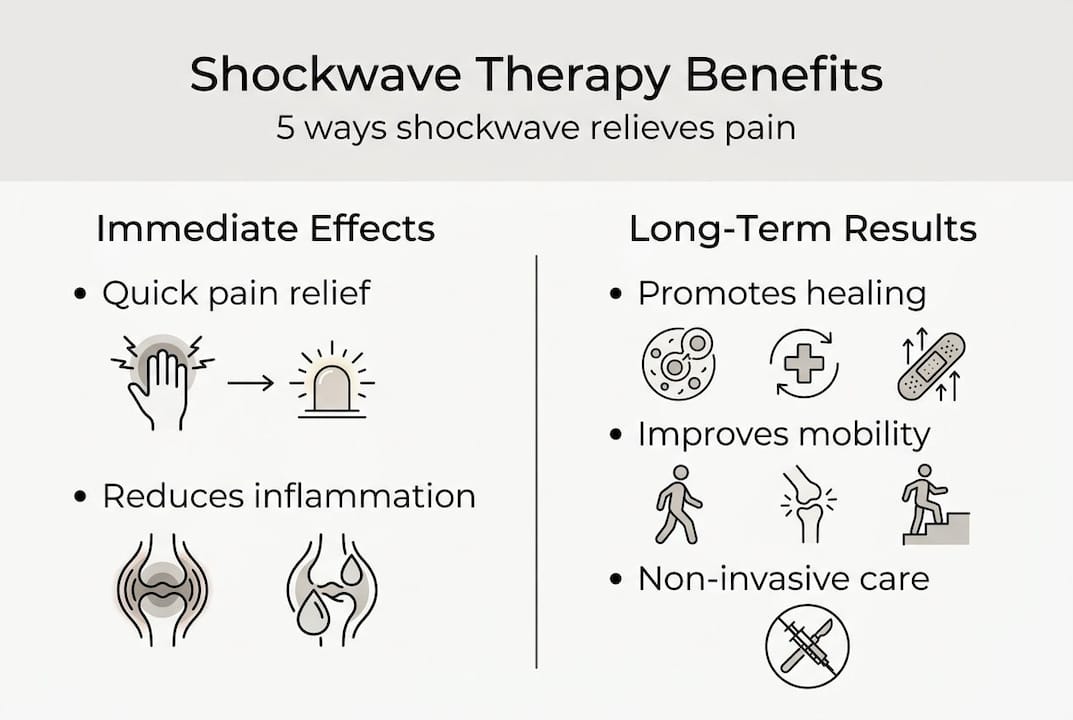
The post-treatment timeline is one of the most misunderstood parts of shockwave therapy. Some people feel immediate relief within hours. Others experience a temporary increase in soreness for 24 to 48 hours before improvement sets in. Both responses are normal.
Here’s what the typical recovery arc looks like:
- Days 1 to 3: Mild soreness or achiness at the treatment site. Avoid high-impact activity.
- Weeks 1 to 4: Gradual reduction in baseline pain. Movement becomes easier and less guarded.
- Weeks 4 to 8: Measurable improvement in function. Most patients report significant changes in their ability to walk, climb stairs, or perform daily tasks.
- Weeks 8 to 12: Peak results for most conditions. Research shows ESWT superior to control by 1.7 points on pain scales and significantly better function in chronic pain conditions at this stage.
Statistic to know: In clinical studies, patients receiving shockwave therapy showed a mean pain reduction of 1.7 cm on the VAS scale compared to control groups, with functional gains that held at 12-week follow-up.
Tracking your progress matters. Keep a simple pain journal rating your discomfort each morning on a scale of 0 to 10. Note changes in your ability to perform specific movements. Bring this log to follow-up appointments.
If you’re not seeing improvement by week 6, that’s a signal worth discussing with your therapist. You may need additional sessions, a different modality, or a more integrated approach. Resources on sound therapy and healing can also provide helpful context on how acoustic-based treatments work over time.
For older adults or those managing long-term conditions, exploring therapy for active aging alongside shockwave can support a more complete recovery. Learning to move better with regenerative therapy is often the goal beyond just pain reduction.
Our Perspective: What Most Guides Miss About Shockwave Therapy
Most resources stop at describing what happens after treatment, but we see a deeper reality in practice every day. The biggest gap in most shockwave guides is the assumption that the treatment works the same way for everyone. It doesn’t.
The best outcomes we see come from individualized protocols, not cookie-cutter approaches. The energy level, probe type, and number of sessions all need to match the specific tissue, the chronicity of the injury, and the patient’s overall movement patterns. A skilled therapist adjusts in real time based on tissue response, not just a preset protocol.
We also see patients skip the screening conversation, assuming they’re fine. That’s where real problems start. Contraindications like anticoagulant use or nearby implants are not rare edge cases. They come up regularly, and missing them creates risk.
Finally, the patients who get lasting results are the ones who treat shockwave as a catalyst, not a cure. Pain relief opens a window. What you do in that window, whether that’s targeted exercise, movement retraining, or a full athlete shockwave guide protocol, determines whether the improvement sticks. Shockwave without rehab is a short-term fix. Shockwave with a personalized recovery plan is a long-term solution.
Next Steps: Get Started With Shockwave Therapy in Lewiston
If you’re ready to explore real relief and confident movement, here’s how to take the next steps.
At RegenTech Physical Therapy in Lewiston, ID, we specialize in exactly this kind of advanced, non-invasive care. Our approach goes beyond symptom relief. We use focused shockwave therapy in Lewiston as part of a structured, three-phase program designed to regenerate tissue, restore function, and help you rise back to full activity.
Whether you’re managing a stubborn tendon injury, chronic heel pain, or a soft tissue problem that hasn’t responded to traditional care, we’re here to help you build a plan that works. Explore more regenerative therapy benefits or learn how our shockwave therapy for athletes program supports faster, more durable recovery. Book your evaluation today and find out if shockwave therapy is the right next step for you.
Frequently Asked Questions
Does shockwave therapy hurt?
You may feel a tapping or vibrating sensation and mild discomfort during treatment, but pain relief is often immediate due to C-fiber overload, and most patients tolerate sessions well.
How soon will I notice results from shockwave therapy?
Many people notice reduced pain within hours or days of their first session, with durable improvement at 8-12 weeks confirmed across clinical studies.
Are there any risks or who should avoid shockwave therapy?
People on anticoagulants or with implants near the treatment area should avoid shockwave therapy, so always screen for implants and disclose all medications before starting.
Is shockwave therapy effective for chronic tendon injuries?
ESWT is superior to control for pain relief and function in myofascial pain syndrome, making it one of the strongest evidence-backed options for chronic tendon and soft tissue conditions.


