

If you’ve been dealing with a problem for months, the frustrating part often isn’t simply that something hurts. It’s that you’ve rested it, modified your activity, tried treatment, maybe had imaging, and you’re still not back to doing what you want to do.
That is the type of situation we see frequently at RegenTech Physical Therapy.
Focused shockwave therapy is one of the technologies we use when we believe improving the local tissue environment may help move recovery forward. But we don’t use shockwave simply because an area hurts, and we don’t view it as a stand-alone fix.
Our job is to figure out what is limiting your recovery, determine whether focused shockwave fits the situation, and then integrate it into a larger plan designed to restore function and rebuild capacity.
What Makes Focused Shockwave Different?
There are different technologies commonly described as “shockwave therapy,” and they are not all the same.
At RegenTech, we use Focused Shockwave Therapy, or FSW.
Focused shockwave allows us to concentrate acoustic energy at a defined depth within the body. That gives us the ability to target specific tissues rather than broadly dispersing pressure across a superficial area.
This can be particularly useful when we’re working with chronic tendon problems, tendon attachment sites, calcific conditions, and other musculoskeletal tissues where precision matters.
The technology matters. But how it is used matters even more.
We don’t select treatment based on a diagnosis alone. Two people can both walk in with “Achilles tendinopathy,” “knee pain,” or “shoulder pain” and need very different approaches.
Step 1: We Figure Out What We’re Actually Dealing With
Before using focused shockwave, one of our Regenerative Physical Therapists performs an assessment.
We’re not simply trying to find the spot that hurts.
We want to understand:
- How long the problem has been present
- What activities aggravate or improve it
- What you’ve already tried
- Your current strength and loading tolerance
- What movements or activities you’re unable to perform
- Whether the involved tissue appears capable of tolerating the demands you’re asking of it
- Whether imaging or other medical findings meaningfully change our clinical reasoning
Imaging can be useful, but we don’t automatically assume that something seen on an MRI or X-ray explains someone’s symptoms. It is one piece of the clinical picture.
Sometimes the clinical picture becomes clearer during treatment itself.
A Recent Example From Our Clinic
Recently, we treated someone who had been dealing with knee pain for several months. MRI had already ruled out significant structural damage, but he was still unable to return comfortably to the weightlifting he wanted to do.
During focused shockwave treatment, one very specific area along the inside of the knee near the kneecap produced a much stronger response than the surrounding tissue.
That finding raised our suspicion that there may have been more going on locally than his previous imaging had shown.
He subsequently underwent diagnostic ultrasound. The ultrasound identified damage involving the quadriceps tendon in the same area that had been particularly symptomatic during focused shockwave treatment.
The shockwave treatment didn’t replace diagnostic imaging, and we wouldn’t use it that way. But in this situation, the tissue response gave us useful additional clinical information that helped guide the next step.
More importantly, it helped us become more specific about where treatment and progressive loading needed to focus so the goal wasn’t simply reducing knee pain — it was getting him back to lifting weights.
That is much closer to how we think about focused shockwave at RegenTech.
Step 2: We Decide Whether Focused Shockwave Actually Makes Sense
Shockwave isn’t automatically appropriate because a condition has become chronic.
We consider the tissue involved, irritability, loading tolerance, medical history, previous treatment, and the person’s goals.
We also screen for contraindications and situations where focused shockwave may not be appropriate.
If we believe it fits the clinical picture, we determine the treatment location, depth, energy level, and other treatment parameters based on the individual rather than following the exact same protocol for everyone.
Step 3: We Deliver Focused Shockwave to the Target Tissue
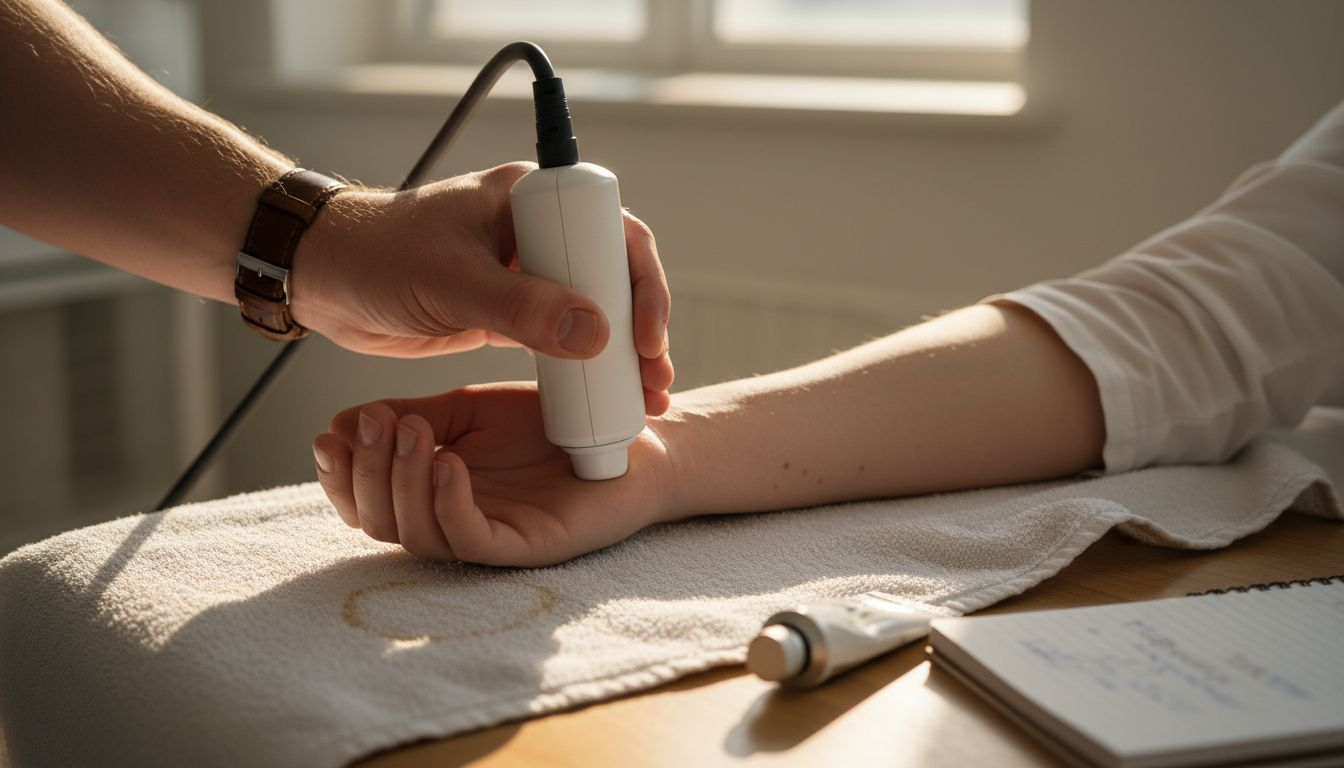
During treatment, we apply coupling gel to the skin and use a handheld applicator to deliver focused acoustic waves into the targeted tissue.
Focused shockwave can be uncomfortable, especially when we’re working over a sensitive or chronically irritated area.
That doesn’t mean something is wrong.
It also doesn’t mean that more pain equals a better treatment.
We adjust treatment intensity based on the tissue being treated, treatment goals, patient tolerance, and response. We’re trying to deliver an appropriate stimulus — not win a contest to see how much discomfort someone can tolerate.
Because focused shockwave energy can be directed to a specific depth, we can also explore the involved region more precisely than we could with a broadly dispersed treatment.
In some cases, differences in tissue sensitivity during treatment can provide another piece of information that contributes to our clinical reasoning.
Step 4: We Reassess Instead of Assuming It Worked
We don’t evaluate the success of treatment based simply on whether the area feels different immediately afterward.
Depending on the condition, we may reassess:
- A movement that was previously provocative
- Range of motion
- Strength
- Loading tolerance
- Functional tasks
- Exercise tolerance
- Symptoms over the following several days
We are looking for meaningful changes in function and capacity over time.
If the person isn’t responding the way we expect, we change the plan.
Sometimes that means modifying the focused shockwave parameters. Sometimes it means changing the loading strategy. Sometimes it means using another RegenTech technology or treatment approach. And sometimes it means recommending additional medical evaluation or diagnostic imaging.
Continuing the same treatment indefinitely just because someone has already started it isn’t good clinical reasoning.
Shockwave Is Not the Entire Rehabilitation
This may be the most important part.
One of the biggest misconceptions about technologies such as shockwave is that the treatment itself is the rehabilitation.
It isn’t.
At RegenTech, we think about recovery through our Regenerate • Restore • Rise framework.
Regenerate
Focused shockwave may be part of the Regenerate phase.
The goal is to improve the tissue environment and address barriers that may be preventing the area from responding normally to progressive loading.
Depending on the situation, this phase may also include technologies such as Class IV laser, dry needling or electro-dry needling, ARPwave, or other interventions.
Restore
Next, we have to restore what the person actually needs.
That may include mobility, strength, neuromuscular function, movement options, loading tolerance, or basic functional capacity.
This is where treatment begins translating into something useful outside the clinic.
Rise
Finally, we build beyond basic recovery.
If someone wants to run, lift heavy weights, ski, work a physical job, compete in a sport, or simply trust their body again, the involved tissues eventually need to tolerate those demands.
That requires progressive loading.
Focused shockwave may help create a better opportunity for recovery, but the end goal is not having a tendon that feels good while lying on a treatment table.
The goal is building a body capable of doing what you need it to do.
How Many Focused Shockwave Treatments Will I Need?
There isn’t one answer for everyone.
The number and frequency of treatments depend on the tissue involved, how long the problem has been present, how the person responds, and what else is happening during rehabilitation.
We reassess throughout the process rather than deciding in advance that every person automatically needs the same number of sessions.
Does Focused Shockwave Hurt?
It can be uncomfortable.
Sensitive tissues may respond strongly during treatment, but discomfort is not the goal. We adjust treatment based on what we’re trying to accomplish and how the individual responds.
You should communicate with your therapist throughout the session so treatment can be modified when appropriate.
Is Focused Shockwave the Right Treatment for Me?
Maybe.
Focused shockwave is a powerful tool, but it is still a tool.
We use it when the clinical reasoning supports it, not simply because someone has a particular diagnosis.
For people dealing with chronic musculoskeletal problems — especially when previous approaches haven’t produced the progress they expected — it can sometimes provide another way to address the tissue while we simultaneously work on the bigger objective:
Regenerate the system. Restore function. Rise back to the demands of life, training, work, and sport.


