

Getting back in the game after a sports injury often feels frustrating when progress stalls or pain lingers. For active adults in Lewiston, ID, a clear diagnosis and a strategy tailored to your specific sport are key, shaping every treatment decision that follows. A recovery plan with realistic, incremental goals—set with a physical therapist—helps prevent re-injury and creates the foundation for long-term mobility and performance.
Step 1: Assess Injury and Set Recovery Goals
Before you can move forward with your physical therapy plan, you need to understand exactly what you’re dealing with. This means getting a proper diagnosis and working with a physical therapist to develop a realistic recovery roadmap. The assessment phase sets the foundation for everything that follows, so taking time to do it right prevents setbacks and wasted effort down the road.
Your physical therapist will start by asking detailed questions about how your injury happened, what movements cause pain, and how your condition affects your daily activities and sports performance. They’ll perform hands-on tests to evaluate your range of motion, strength, stability, and how your body compensates for the injury. These clinical observations matter because compensation patterns often develop quickly after injury. For example, if your left knee is injured, you might unconsciously shift weight to your right leg, which can lead to problems there too. A comprehensive evaluation also involves understanding rehabilitation strategies that work for your specific sport, since the demands on a runner’s knee differ greatly from those on a tennis player’s shoulder or a cyclist’s hip.
Once your PT understands the injury, you’ll establish recovery goals together. These need to be realistic and specific, not vague wishes. Instead of “get better,” you might set goals like “regain full knee extension without pain in 3 weeks” or “return to running at 70 percent intensity within 6 weeks.” Setting incremental goals keeps you motivated and gives you clear markers of progress. The research shows that recovery periods typically take twice as long as the initial injury downtime to prevent compensatory injuries and ensure complete healing. Your therapist will factor in your specific sport and position, creating a plan tailored to what your body needs to perform at your best when you get back in the game.
Pro tip: Write down your goals and share them with your physical therapist before your first session, including your target return date to your specific sport and any lingering concerns you have about movement or performance.
Step 2: Select Advanced Physical Therapy Techniques
Now that you understand your injury and have clear recovery goals, it’s time to choose the specific techniques that will get you there fastest. Your physical therapist will recommend advanced modalities based on your injury type, your sport, and what the current research supports. Think of this step as customizing your treatment plan rather than following a generic protocol off the shelf.
Your PT will discuss several options with you, which may include manual therapy, therapeutic exercises designed specifically for your injury, neuromuscular reeducation to retrain how your body moves, and functional training that mimics the demands of your sport. The key is that these aren’t random choices. Individualized exercise prescriptions concerning mode, intensity, frequency, and timing make the difference between a recovery that stalls and one that accelerates. For a knee injury, your program might look completely different than someone treating a shoulder problem, even if you’re both athletes. Some conditions benefit from starting with lower intensity aerobic work before progressing to resistance training, while others require immediate neuromuscular focus. At RegenTech, we often integrate cutting-edge modalities like laser therapy, shockwave therapy, or blood flow restriction alongside traditional exercises to amplify your results. Advanced physical therapy protocols for sports injuries incorporate the latest clinical practice guidelines tailored to specific injuries like ACL tears, tendinopathies, and ligament repairs.
During your consultations, ask your therapist why they’re recommending each technique and what outcomes you can expect on a specific timeline. Not all advanced techniques are appropriate for every injury or every stage of recovery. For instance, some methods work best early in the healing process, while others become valuable only after you’ve regained basic stability and strength. Your therapist should explain the reasoning behind each choice, helping you understand how the pieces fit together to move you toward your goals and back to your sport.
Pro tip: Ask your physical therapist to explain which techniques address which aspects of your injury, so you understand how each modality contributes to your overall recovery strategy.
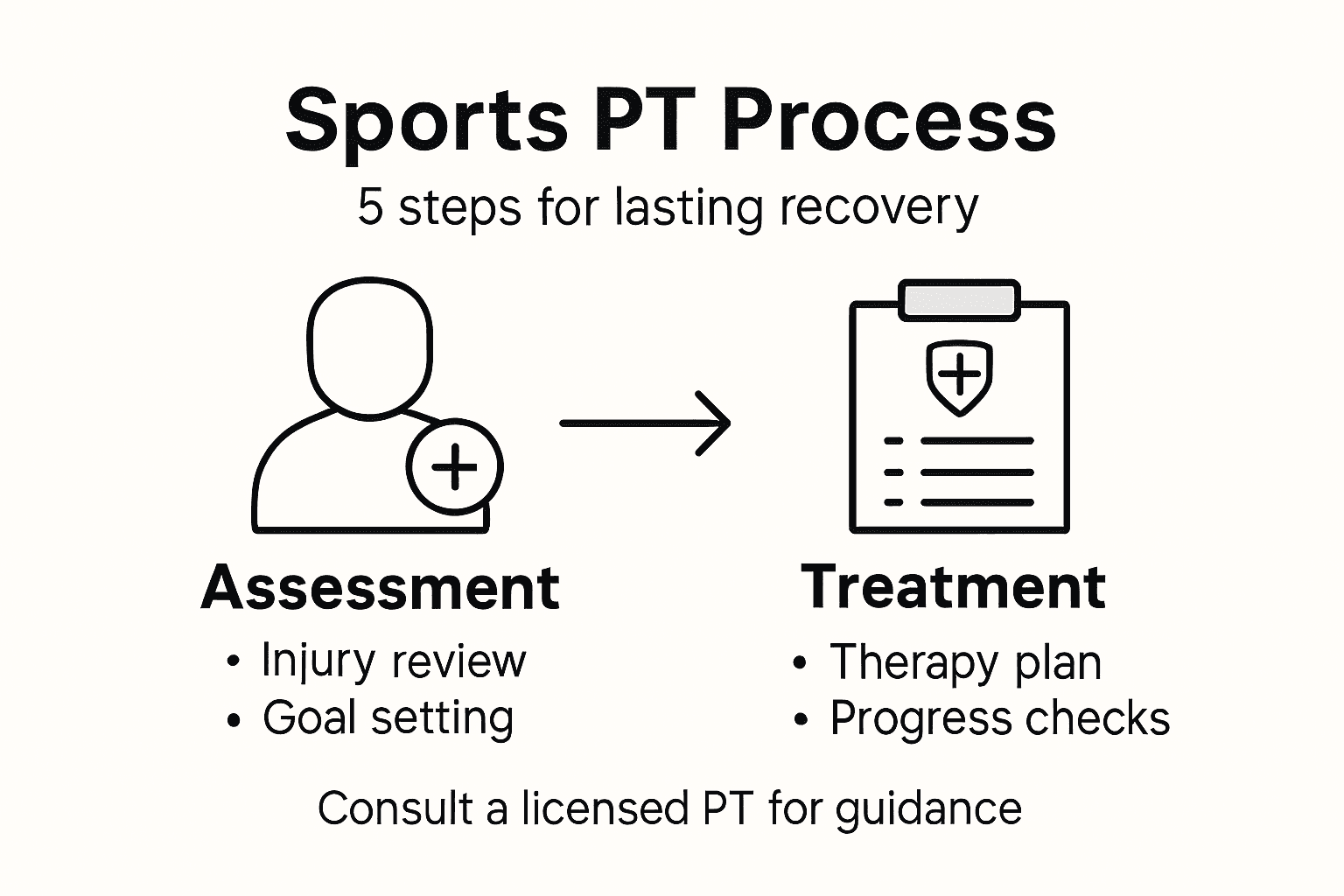
Below is a summary of featured advanced physical therapy techniques and their unique benefits for sports injury recovery:
| Technique | Purpose | Typical Benefit |
|---|---|---|
| Manual therapy | Improve joint mobility | Faster pain relief |
| Neuromuscular reeducation | Retrain proper movement patterns | Reduced compensation injuries |
| Blood flow restriction | Enhance muscle strength safely | Speeds early strength gains |
| Shockwave therapy | Stimulate tissue healing | Shortens recovery timeline |
| Sport-specific exercises | Mimic athletic demands | Improved return-to-sport rate |
Step 3: Implement Targeted Treatment Sessions
This is where your recovery actually happens. Your treatment sessions are designed specifically for you, not as a generic workout but as a precise intervention tailored to your injury and your sport. Each session builds on the previous one, systematically restoring strength, flexibility, and the movement patterns you need to perform at your best.

When you arrive for a session, your therapist will check in on your pain levels and how you’ve progressed since your last visit. Targeted treatment sessions focus on exercises that restore strength, flexibility, and function relevant to your sport, meaning a baseball pitcher’s shoulder program looks completely different from a soccer player’s ankle rehab. Your PT will monitor your pain and functional capabilities closely, adjusting the intensity and type of work based on how you’re responding. If you’re doing too well, they’ll progress you. If something isn’t working or is causing setbacks, they’ll modify the approach. This constant feedback loop is what separates effective recovery from programs that plateau. Many sessions will include hands-on work from your therapist combined with active exercises you perform yourself. You might spend time on joint mobility, then move into strength training, and finish with movement patterns specific to your sport. Outside the clinic, you’ll have a home exercise program designed to reinforce what you learned during your session. Consistency with these exercises often matters more than the sessions themselves.
Treatment progression follows a logical sequence. Early sessions focus on restoring basic motion and reducing pain. As you improve, the work shifts toward building strength and stability. Returning to sport after injury requires restoring joint motion, strength, and neuromuscular control through progressive loading and sport-specific drills. Your therapist will gradually introduce movements that mimic your sport, preparing your body for the real demands you’ll face. Trust the process, even when progress feels slow. Recovery isn’t linear, and patience at this stage prevents the re-injury that derails countless athletes.
Pro tip: Keep a brief recovery journal noting how you felt during and after each session, which exercises felt most challenging, and any patterns you notice in your pain or mobility; this information helps your therapist fine-tune your program and accelerates your progress.
Step 4: Track Progress and Adjust Your Regimen
Recovery isn’t a straight line, and neither should your treatment plan be. Progress tracking keeps you and your therapist aligned on what’s working and what needs to change. Without systematic monitoring, you might spend weeks repeating exercises that aren’t moving you forward or miss the signs that you’re ready to progress to harder challenges.
Your physical therapist will regularly assess your strength, range of motion, pain levels, and functional abilities throughout your recovery. These assessments tell a story about whether your current regimen is effective or needs modification. Tracking progress through regular assessments of strength, range of motion, and pain is essential for determining treatment effectiveness and keeping you motivated toward your recovery goals. Your PT might test your knee stability with specific movements, measure how far you can bend or straighten your shoulder, or evaluate how well you can perform sport-specific movements without pain. Each of these markers provides concrete data, not just subjective feelings. You’ll notice when something changes because your therapist will point it out and celebrate it with you. If you’ve regained 15 degrees of motion or added 20 pounds to your leg press, that’s progress worth acknowledging. Beyond the clinical tests, pay attention to how your body feels during daily activities. Can you walk up stairs without pain? Can you sprint without hesitation? These real-world indicators matter as much as formal measurements.
When progress plateaus or symptoms reappear, your regimen gets adjusted. This is normal and expected, not a sign of failure. In sports injury rehabilitation, if symptoms reappear during progression steps, activities are halted and regimens are modified accordingly. Your therapist might reduce intensity temporarily, add a different modality, or shift focus to an area that needs more attention. This careful, stepwise approach minimizes re-injury risk and ensures you only progress when your body is truly ready. Communication during this phase is critical. If something hurts or doesn’t feel right, tell your therapist immediately rather than powering through. The goal isn’t toughness. The goal is getting you back to your sport permanently, not for a week before another setback.
Pro tip: Track your own metrics between sessions by noting your pain level on a scale of one to ten, which exercises felt easiest or hardest, and how you felt during activities like running or sport-specific movements; share this with your therapist to help guide progression decisions.
Step 5: Maintain Strength and Prevent Future Injuries
You’ve worked hard to get back to your sport. Now the real challenge begins: staying healthy long-term. The difference between athletes who return successfully and those who re-injure themselves within months often comes down to what happens after physical therapy officially ends. You need a maintenance strategy that keeps your body strong, mobile, and resilient against future injuries.
Maintaining the gains you’ve made requires ongoing conditioning and smart movement strategies. Maintaining strength post-recovery involves continued conditioning and movement strategies that support joint stability and muscular balance. This doesn’t mean spending hours in the gym every day. It means integrating targeted strength work into your regular training schedule, focusing on the areas that were injured and the movement patterns your sport demands. If you had an ankle sprain, you’ll want to continue proprioceptive training, which teaches your ankle how to respond when it’s challenged. If your shoulder was your weak point, you’ll maintain the rotator cuff and scapular stability work even after you’re pain-free. The key is consistency. Many athletes skip maintenance work once they feel better, only to find themselves injured again months later. Your physical therapist can recommend a maintenance program tailored to your specific needs and your sport.
Injury prevention goes deeper than just the area that was injured. Preventing future injuries involves education, systematic injury surveillance, and evidence-based prevention strategies implemented across all levels of sport participation, including strength programs and neuromuscular training. This means understanding your personal risk factors, developing body awareness during high-risk movements, and building capacity before you need it. Injury prevention through capacity building focuses on making your body more resilient, not avoiding activity. You’re teaching your muscles to handle unpredictable forces, your joints to stabilize in multiple directions, and your nervous system to respond quickly when things go wrong. Work with your physical therapist to develop a year-round injury prevention routine that complements your sport. This might include dynamic warm-ups, mobility work, strength progressions, and sport-specific agility drills. Your past injury is actually valuable information. It tells you exactly where your body is vulnerable, and that’s where prevention efforts should focus.
Pro tip: Schedule a brief check-in with your physical therapist every three to four months, even after recovery is complete, allowing them to reassess your strength, mobility, and movement quality before small issues become major problems.
The table below compares key strategies for long-term injury prevention after physical therapy ends:
| Strategy | How It Protects You | When to Apply |
|---|---|---|
| Consistent strength training | Maintains muscle balance | Weekly throughout training |
| Proprioceptive exercises | Prevents joint instability | Focus on prior injury sites |
| Injury surveillance | Detects early recurrence signs | Quarterly PT check-in |
| Dynamic warm-ups | Prepares body for sport demands | Every session before activity |
| Capacity building | Enhances resilience to forces | Integrate into normal routine |
Take Your Sports Injury Recovery to the Next Level with RegenTech
Recovering from a sports injury is more than just managing pain. It requires a carefully tailored plan that addresses your unique challenges—whether it is regaining mobility, restoring strength, or preventing future setbacks. This article highlighted how setting clear goals, selecting advanced physical therapy techniques, and tracking progress are essential to becoming game-ready again. At RegenTech Physical Therapy, we specialize in cutting-edge treatments designed to accelerate healing and help you rise stronger than ever.

If you are looking for expert care that combines innovative technology like blood flow restriction and shockwave therapy with personalized strategies focused on your sport and lifestyle, RegenTech is your partner in recovery. Explore our Innovative Treatments Archives – Regentech Physical Therapy to learn how our approach sets us apart. Ready to move better and perform at your peak Discover more about maintaining lasting strength and flexibility in our Movement & Mobility Archives – Regentech Physical Therapy and start your journey today. Visit us at RegenTech Physical Therapy to schedule your first session and take the first step toward a stronger, healthier you.
Frequently Asked Questions
What should I expect during my initial physical therapy assessment?
You can expect your physical therapist to conduct a thorough evaluation of your injury, including a discussion of how it occurred and its impact on your daily activities. Be prepared to answer specific questions about your pain levels and functional mobility, which will help set the foundation for your treatment plan.
How can I set realistic recovery goals with my physical therapist?
Start by discussing your specific needs and what you want to achieve, such as returning to a particular sport or activity. Collaborate with your therapist to set measurable targets, like regaining full mobility within three weeks or achieving specific strength milestones within six weeks.
What advanced techniques might my physical therapist recommend for my injury?
Your physical therapist may suggest various advanced treatments tailored to your specific injury, such as manual therapy, neuromuscular reeducation, or sport-specific exercises. Discuss the purpose and expected outcomes of each technique to understand how they contribute to your recovery.
How can I effectively track my progress during physical therapy?
Maintain a recovery journal to record your pain levels, achievements, and challenges after each session. Share this information with your therapist to help them adjust your treatment plan and keep you focused on your recovery goals.
What can I do to prevent future injuries after completing physical therapy?
Focus on maintaining strength and mobility through consistent conditioning and targeted exercises. Integrate injury prevention strategies, such as dynamic warm-ups and proprioceptive training, into your regular training routine to minimize the risk of re-injury.


